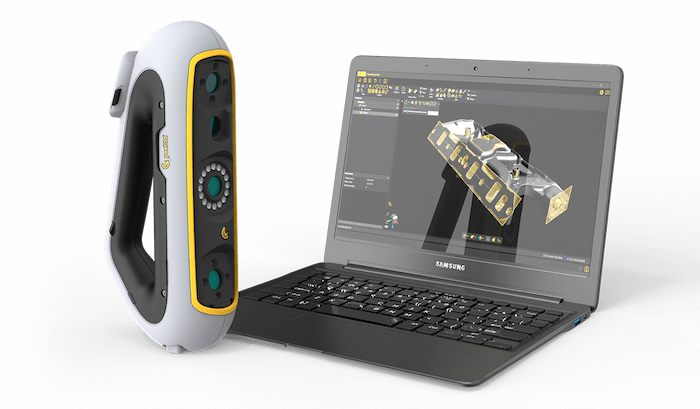
Reengineering Agricultural Implements and Attachments Using 3D Scan Data
The Limitations of Manual Data Collection in Prototype Development
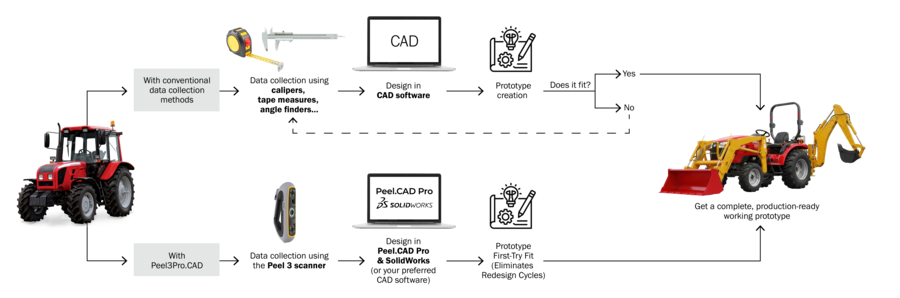
To produce a fully functional, production‑ready prototype without 3D scanning, the first step is extensive manual data collection. This requires measuring existing components point by point and line by line, with special attention to critical geometries, particularly the areas where the new part must interface or attach. Dimensions such as lengths, widths, heights, radii, hole positions, angles, and curves must all be captured accurately so they can be reproduced later in the design phase.
Because this process depends on manual measurement tools and visual estimation, it is common for information to be incomplete or for certain details to be overlooked. As a result, it is often necessary to revisit the site to gather missing data, extending timelines and increasing project costs.
During the design phase, all collected measurements must be reproduced manually in CAD software. Engineers must ensure that every dimension is consistent with the real‑world geometry and verify that no interferences or alignment issues exist. Reference photos become essential for confirming shapes and validating that the 3D model is both accurate and complete. Once the design is finalized, a prototype is fabricated and tested on the agricultural equipment to evaluate fit, form, and function. In many cases, the first prototype does not fit correctly. This requires gathering new feedback, adjusting the CAD model, producing another prototype, and returning to the site for additional testing. This cycle often repeats until the prototype finally fits as intended.
First Try Fit: How 3D Scanning Eliminates Redesign Cycles
For companies that have integrated 3D scanning technology into their workflow, the process looks entirely different. Scanning captures complete and accurate dimensional data in minutes, greatly reducing the risk of missing information and enabling engineers to produce a prototype that fits correctly on the first attempt.
With tools like Peel.CAD Pro, advanced algorithms simplify alignment, automatically extract geometric entities, and allow direct transfer into SolidWorks or other preferred CAD platforms. This dramatically accelerates reverse engineering and redesign work, making the entire process faster, more precise, and more reliable than ever.
Comprehensive Scan to CAD Workflow for Agricultural Equipment Redesign
In the video, the front loader mounting frame was scanned to capture the exact attachment or mounting— points, which serve as the reference for designing precise, tractor specific implements. The bucket was also scanned in high detail to support the design of a new bucket tooth with accurate geometry and alignment.
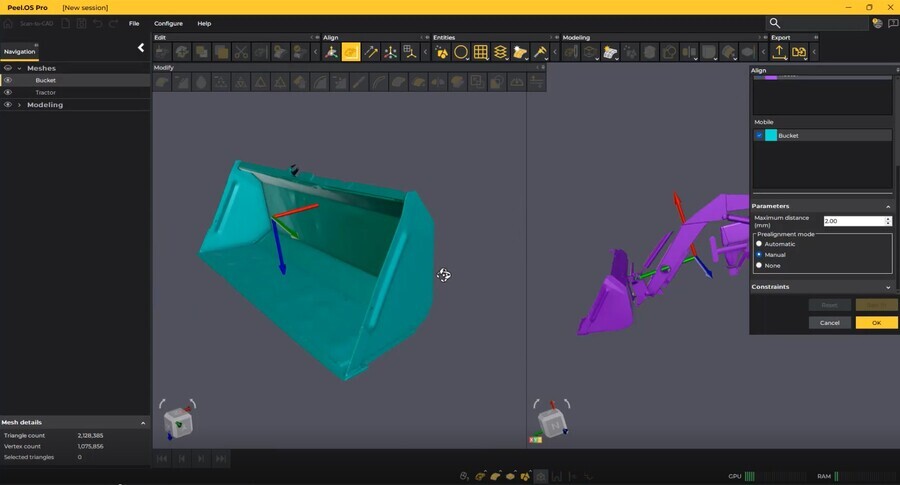
The scan data was imported into Peel.CAD Pro for reverse engineering. After mesh cleaning to remove noise and unwanted geometry, the two datasets were aligned using Best Fit Alignment with a manual point pair pre alignment. This method is ideal for large agricultural components with limited surface overlap.
Once aligned, the meshes were merged into a single continuous STL, renamed as the final merged model, and used to extract key geometric references: planes, circles, cylinders, and cross sections. These elements define mounting interfaces, check clearances, and ensure compatibility with the tractor structure. The mesh and reference geometry were then transferred directly into SolidWorks.
Curious to see the full process in action? Watch our video demonstration here
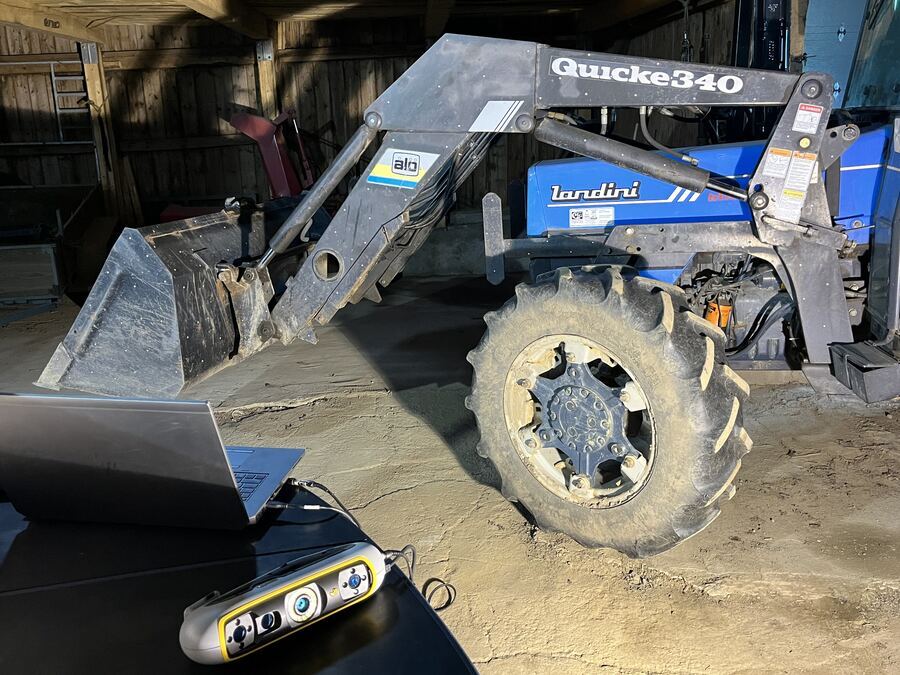
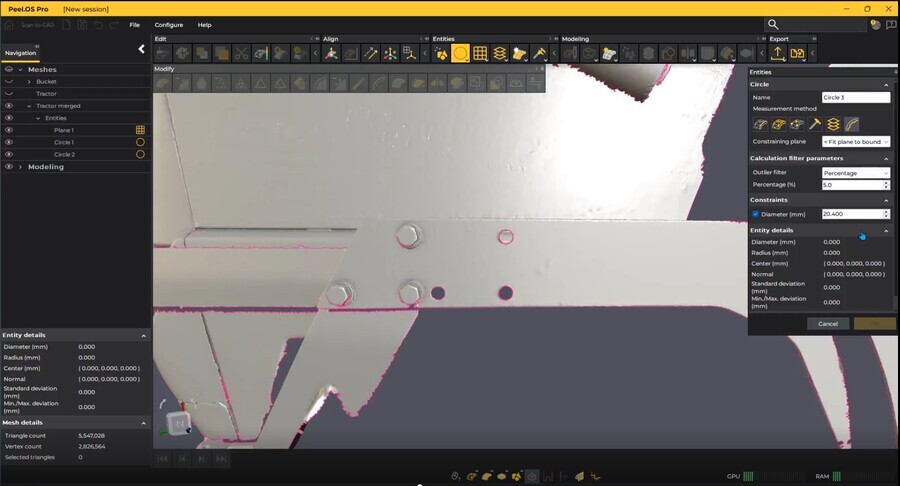
This streamlined scan to CAD workflow enables fast, accurate development of replacement parts and custom attachments. With Peel 3D scanners and Peel.CAD Pro, manufacturers can minimize downtime, improve dimensional accuracy, and accelerate innovation in agricultural equipment design.
The Competitive Edge of Modern Scan to CAD Processes
Integrating 3D scanning and Peel.CAD Pro into your engineering workflow delivers a series of powerful advantages that directly impact efficiency, product quality, and business growth. By capturing accurate geometry from the start, you significantly reduce design time, eliminating the need for repeated measurements and manual modeling. This precision also allows you to produce a prototype that fits perfectly the first time, avoiding costly rework and accelerating every stage of development.
As a result, your entire production pipeline moves faster, helping you accelerate your time to market and respond quickly to customer needs. Presenting accurate digital models and well fitting prototypes also allows you to look more professional in front of your customers, reinforcing trust and positioning your brand as a modern, technologically advanced partner.
With fewer redesign cycles and less time wasted fixing avoidable errors, you free up valuable engineering hours, allowing you to take on more contracts, deliver projects sooner, and increase overall productivity. Ultimately, adopting 3D scanning gives you a competitive edge over other attachment manufacturers, enabling you to offer higher accuracy, better quality, and faster turnaround times in a market where speed and precision matter.
Wonder how Peel 3D can transform your work, solve problems, and save you time?
Contact our Peel 3D experts