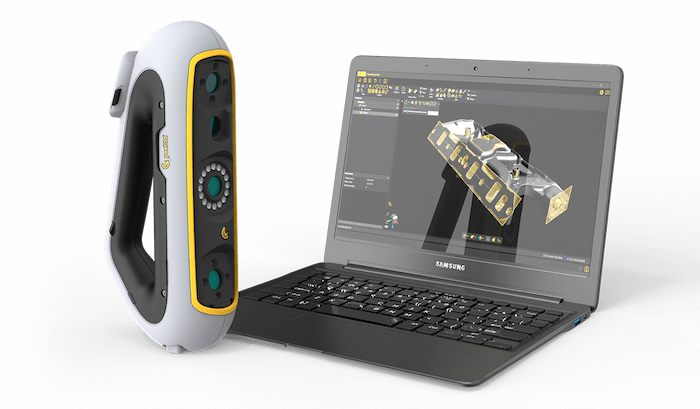
How Velling Teknik Uses Peel 3D to Design Custom Van Interiors
Custom Van Interiors Built from Accurate 3D Scan Data
Standard van storage systems often make poor use of the available room. Shelves come in predetermined sizes, equipment ends up on the floor, and gaps remain around doors, wheel arches and curved body panels. Even customizable systems usually limit the buyer to a catalogue of components.
Velling Teknik scans entire vehicles, designs each component around the digital model, and manufactures parts for specific interiors. During a Peel 3D webinar, company founder Klaus Christensen demonstrated how the process replaces difficult manual measurements with high-performance 3D scanners from Creaform.
About Velling Teknik
Based in western Denmark, Velling Teknik was founded after Klaus repeatedly encountered disorganized mobile workshops and work vehicles. A machinist with 30 years of experience, he saw how poor storage left tools inaccessible and work surfaces cluttered.
On construction sites, he found that vans belonging to bricklayers, plumbers, carpenters and electricians often contained costly storage systems that did not suit their tools or job routines. Velling Teknik began developing interiors based on the customer’s requirements rather than adapting the work to a standard product range.
The Challenge: Making Van Interiors Better Fit the Work
While working on construction sites, Klaus kept seeing the same problem. Bricklayers, plumbers, carpenters, and electricians had invested in professionally supplied van storage systems, yet tools still ended up on the floor, leaving usable space empty. The systems were described as customized, but most were assembled from a limited catalogue of standard components.
Creating an interior around the owner’s actual equipment meant accounting for several constraints:
- Curved sidewalls and irregular body panels
- Structural ribs, wheel arches and cabin trim
- Sliding-door tracks, latches and other moving parts
- The size, weight and frequency of use of each tool
- Safe placement of heavy equipment
- Clear access to tools during the workday
Capturing this geometry manually would require extensive measuring and validation mock-ups. Even then, a panel that appeared correct on paper might interfere with a door mechanism or fail to follow the vehicle’s contours once installed.
Velling Teknik needed accurate 3D measurements that could be used directly during design and manufacturing. The company adopted a Peel 3D scanner and Scan-to-CAD tools to create a digital model of the van interiors before deciding where each partition, shelf and storage component should go.
The Solution: 3D Scanning Van Interiors with Peel 3D
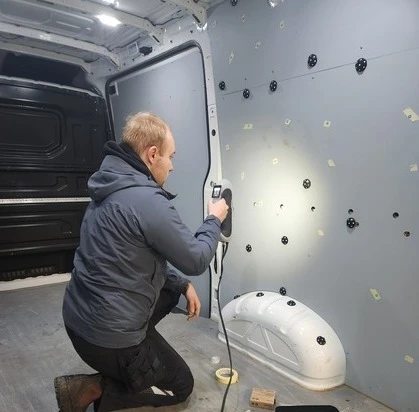
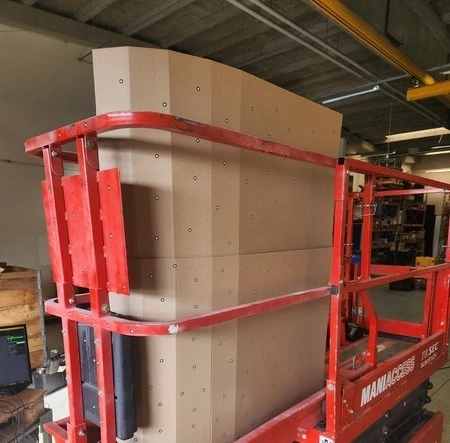
For Klaus, the design process begins inside the empty van, before a single panel or shelf is drawn. He first prepares the area with positioning targets that help the Peel 3D scanner maintain its position across broad, uniform panels and around the vehicle’s many corners. His setup includes magnetic strips and reusable 3D-printed target holders, some fitted with magnets and others with adhesive backing.
Rather than attempting to capture the entire interior at once, Klaus divides it into several manageable scans. During one project, preparing the selected area took approximately 15 minutes, followed by another 15 minutes of scanning. This gave him the geometry of the van’s left side and part of the front without spending hours recording individual measurements.
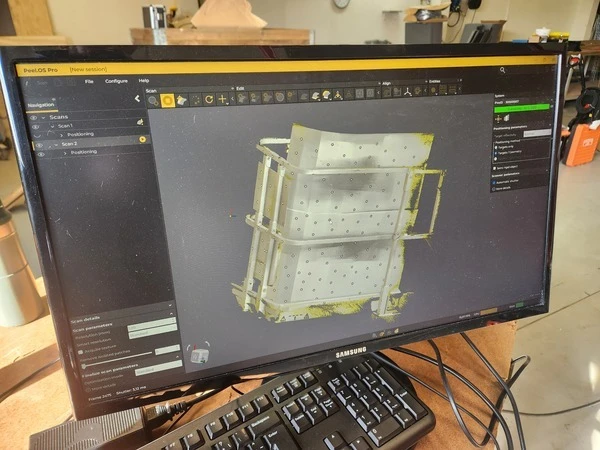
Klaus then cleans each scan separately before selecting three or four common targets to align and merge the datasets. Working with several smaller captures keeps the files easier to handle and allows him to check each area before assembling the complete digital model.
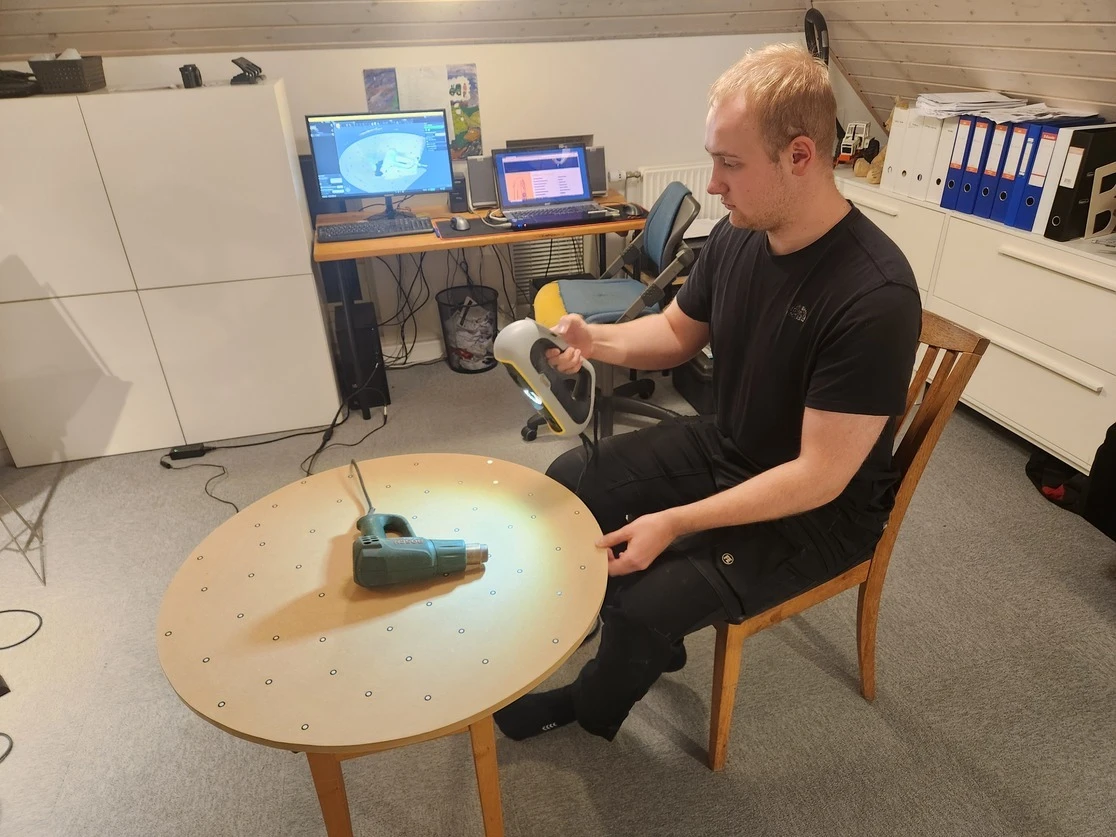
He also adjusts the scan resolution according to what he is capturing. A large interior panel does not require the same level of detail as a power tool or small mechanical part. By collecting only the detail needed for the layout, Klaus creates a lighter digital model that remains accurate enough to guide the design of the van’s fitted components.
Turning Scan Data into Production-Ready Panels
Once the scans have been merged, Klaus positions the model along the X, Y and Z axes and begins planning the vertical panels. He places a cross-section at each proposed location, using the scan to check what passes through that plane. Choosing the correct location requires familiarity with the van. A section drawn too close to the cabin or through a sliding-door stop will not produce a usable part.
Once the location is correct, the cross-section supplies the outline for a closed sketch. Klaus extrudes that sketch to create the first panel, then repeats the process wherever the design calls for another divider or support. He prefers to complete these steps in Peel.CAD Pro, 3D scanning software designed for reverse engineering and product design. Klaus can also transfer 3D scanning data to CAD platforms, such as Fusion, Inventor or SOLIDWORKS.
As a result of this new process, customers can see how the proposed components relate to the real vehicle before approving the layout. Adjustments happen in the model while they are still straightforward, rather than beside the van after a panel has already been cut.
After approval, the CAD files go to a CNC supplier. The panels arrive cut to shape and prepared with the required holes, allowing the interior to be shipped as a kit and assembled much like a puzzle. The files remain available if a component is damaged and a replacement is needed.
They also give the system a life beyond its first vehicle. When an owner changes vans, Klaus scans the new interior and designs new fitted panels for its geometry. Shelves, boxes, and specialized holders that still serve the customer can then be incorporated into the next layout rather than discarded.
Building Storage Around the Customer’s Tools
For one compact van, Klaus began by documenting what the owner carried and where each item needed to be reached. He then designed the boxes, openings and drawers around that inventory, fitting into the vehicle what might otherwise have required a larger model.
The arrangement followed a practical hierarchy. Heavy equipment stayed near the floor, rarely used items moved higher, and everyday tools received dedicated positions within easy reach. Klaus applies a “one-touch” rule: when someone finishes using a tool, it should take one movement to return it to its assigned place.
Velling Teknik used 12 mm wood for this project, although the material and thickness can change when heavier equipment requires more support. Klaus also has to consider the vehicle’s maximum allowable weight when specifying stronger components.
See Klaus’s Complete Workflow
In a recent Peel 3D webinar, Klaus demonstrates the complete process and answers practical questions about applying it to custom van interiors.
Taking the Same Workflow Beyond Trade Vans
Klaus streamlined this workflow around the needs of tradespeople, but the same approach can support vehicles designed for very different purposes. The method can be adapted to other conversions in which equipment must fit within an irregular vehicle body:
- Camper vans: Cabinetry, beds, appliances, water systems and electrical equipment can be planned around structural features and checked for clearance before fabrication.
- Delivery vehicles: Bins, shelving and restraints can follow package sizes, loading sequences and access points.
- Mobile workshops: Workbenches, machinery, power supplies, and tool storage can be designed as a single coordinated work area.
- Service and repair vehicles: Parts and diagnostic equipment can be arranged according to service processes, while established storage modules can be adapted to different vehicle models.
Key Takeaways
More Reliable Measurements
Peel 3D records curves, corners and surrounding features that are difficult to capture with tapes and templates.
Less Development Time
In the webinar example, one section was prepared and scanned in approximately 30 minutes. Cross-sections can then be derived without tracing each profile by hand.
Faster Customization and Deployment
CAD revisions take place before production, while CNC-ready files shorten the path from approval to installation.
A Layout Designed for Real Work
Storage locations, materials and component strength can be selected for the tools, loads and work methods associated with the vehicle.
Discover more ways to use Peel 3D
When the Customer Truly Becomes Part of the Design Process
Customers often begin by asking Klaus which layouts they can choose from. They are not accustomed to being told that the interior can be designed around their own tools, priorities and working habits. Once they understand that there is no predetermined layout, the conversation changes. They begin thinking about where each item should go and how to optimize their teams’ daily routines.
For Klaus, that freedom to design around each customer is the strongest reason to leave traditional measuring methods behind.
Interested in exploring how Peel 3D can help your product design and reverse engineering projects?
FAQs About 3D Scanning for Vehicle Conversions
When is 3D scanning most useful for a vehicle conversion?
3D scanning is particularly useful when the interior contains curved surfaces, tight clearances or several components that must fit together precisely. It can also be valuable for one-off conversions where building and correcting physical templates would consume a significant portion of the project time.
What information should be gathered before scanning a vehicle interior?
The project team should document the equipment being installed, its approximate weight, how frequently each item is used and where it needs to be accessed. Electrical, ventilation, plumbing, payload and fastening requirements should also be identified before the layout is finalized.
Can only part of a vehicle interior be scanned?
Yes. A partial scan may be sufficient when the conversion is limited to one wall, the cargo area or a specific mounting location. The scan should still include enough surrounding geometry to position the new components correctly and identify nearby trim, structural features or moving mechanisms.
Can the same digital model be used for every van of the same make and model?
An existing model can provide a useful starting point, but the vehicle should still be checked before production. Model-year changes, factory options, previous modifications and normal manufacturing variation can affect the available space and mounting locations.
Does 3D scanning eliminate the need for a final fit check?
No. 3D scan data provides a more reliable basis for design, but the finished components must still be checked against the physical vehicle. Material behaviour, assembly tolerances, fastening methods and the movement of doors or other mechanisms can all affect final installation.
Does the digital model account for vehicle payload and safety requirements?
The model can support component placement and space planning, but it does not replace payload calculations or regulatory review. The weight of the interior, tools, equipment, occupants and other cargo must be evaluated against the vehicle manufacturer’s specifications and applicable conversion requirements.
Wonder how Peel 3D can transform your work, solve problems, and save you time?
Contact our Peel 3D experts