Application case: Modus Boat Scanning and post-processing
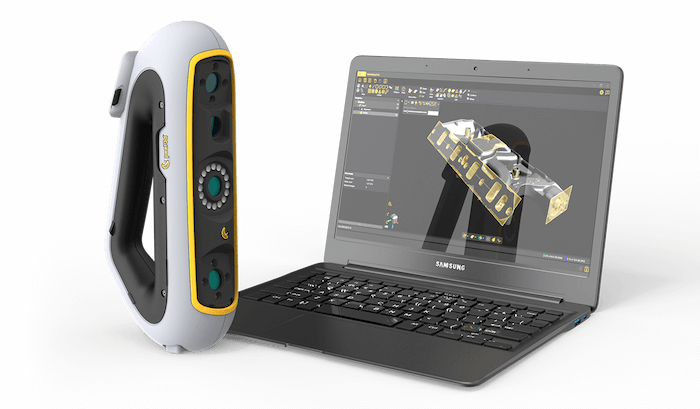
Accurate geometry is the foundation of every successful product development project in the marine industry, from refits and retrofits to performance analysis and premium customization. In this application study case, we take a closer look at the 3D scanning and post‑processing of a Modus boat, captured using a Peel 3 handheld 3D scanner and post-processed in Peel.CAD Pro.
Featured in the accompanying YouTube video (Peel 3D Modius Boat Project v4), the project demonstrates a complete, marine scanning workflow, from data acquisition to a clean dataset.
Project Overview: Capturing the Modus Boat
The Modus boat was scanned across three dedicated sessions, capturing the deck and major exterior geometry. This approach ensured full surface coverage while maintaining high accuracy and repeatability. The result is a comprehensive digital representation of the vessel’s exterior, ready for engineering, design, and manufacturing applications.
Post‑Processing in Peel.CAD Pro — Step by Step
Once scanning was complete, the data was refined using a structured post‑processing workflow in Peel.CAD Pro:
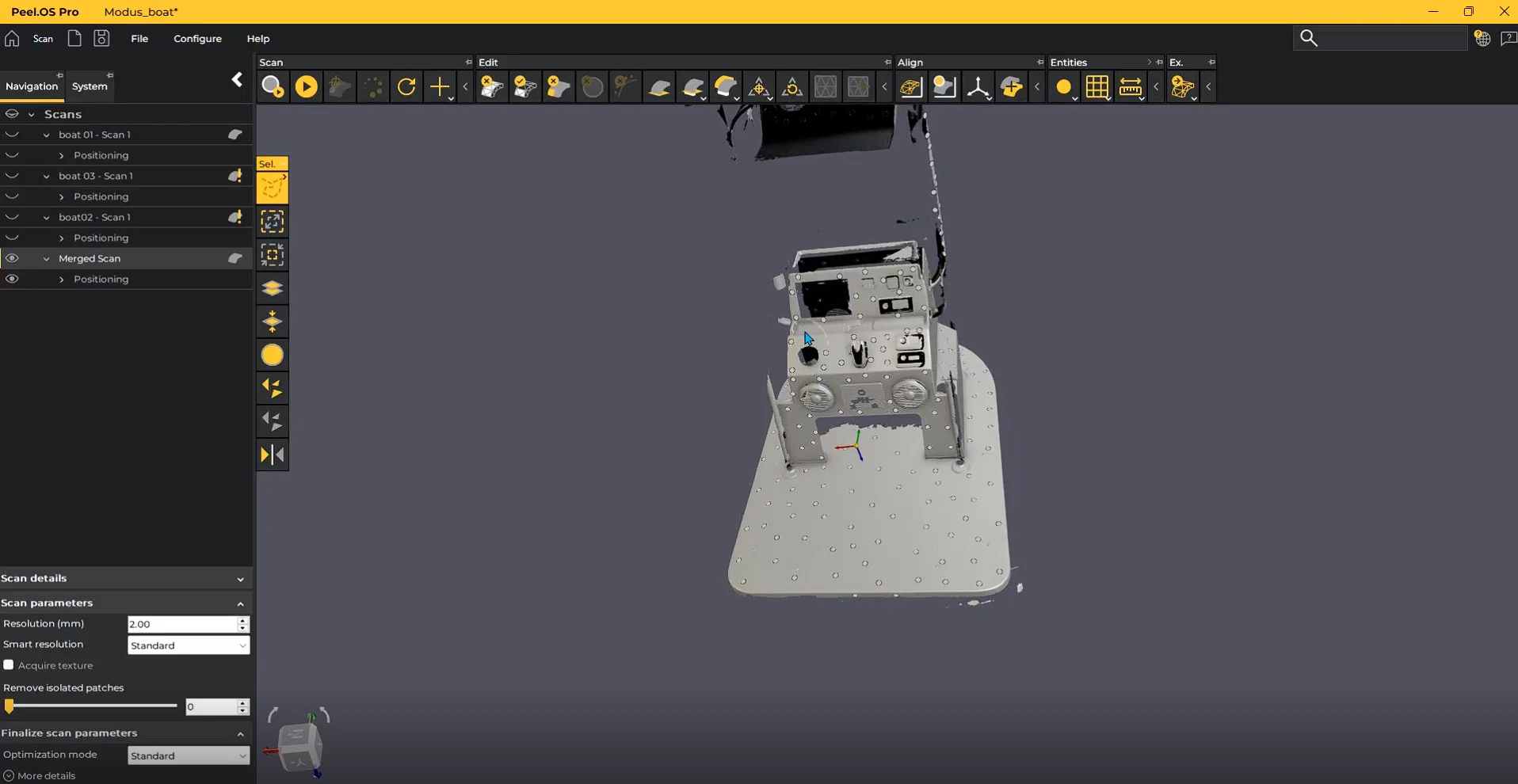
1. Merge Scan Sessions
The three individual scan meshes were merged into a single, continuous model. This unified dataset provides a clean and reliable foundation for reverse engineering and analysis.
2. Clean the Scan
Stray points, noise, and out‑of‑scope geometry were removed to improve mesh quality and ensure accurate alignment and measurement.
3. Create Alignment Entities
A symmetry plane and two perpendicular reference planes were defined. These entities establish robust, repeatable references—critical for naval architecture work, hydrodynamics studies, and design workflows.
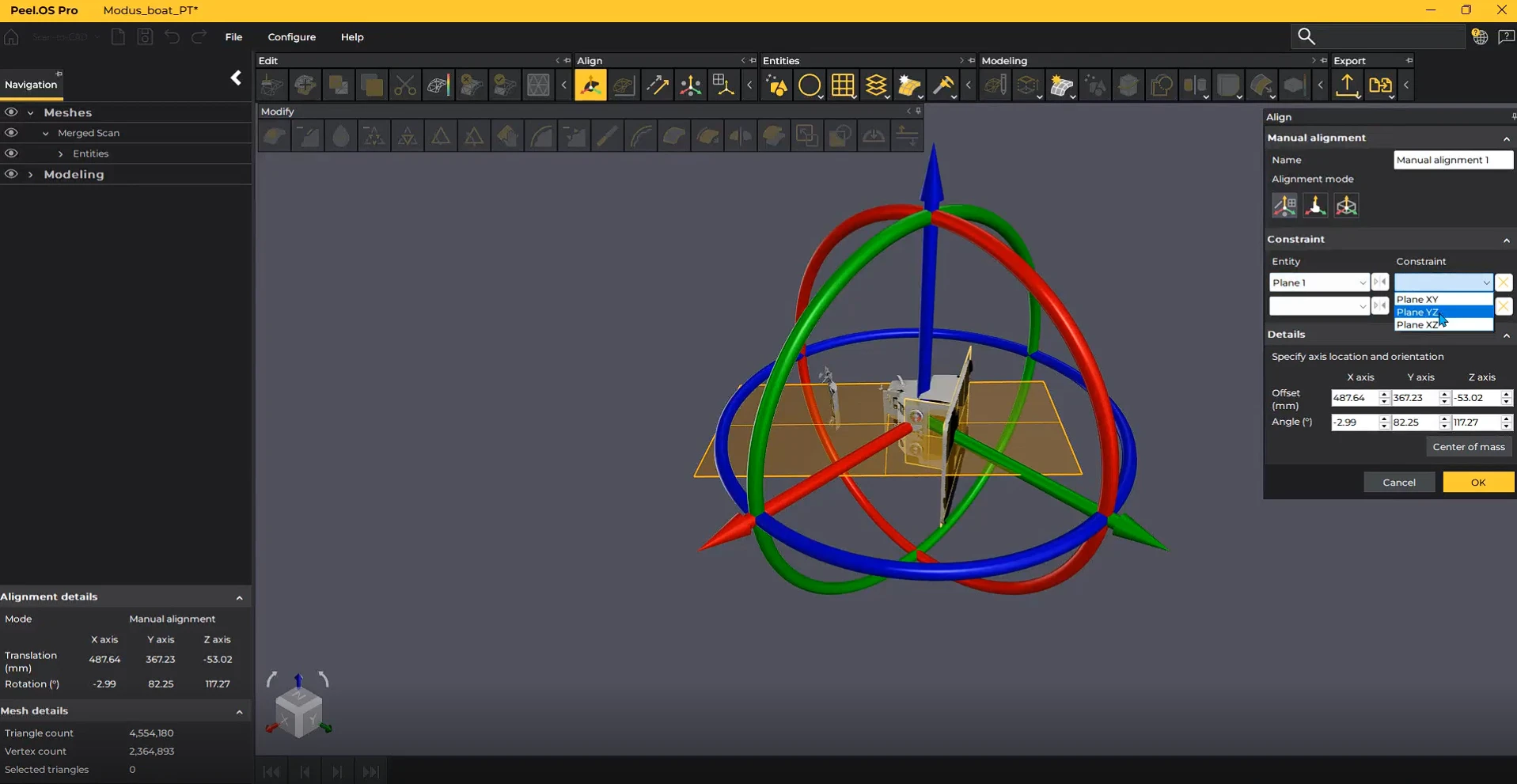
4. Align to the Coordinate System
The model was oriented into a consistent engineering coordinate frame, enabling precise downstream CAD, and manufacturing workflows.
5. Mirror the Mesh Using the Symmetry Plane
Using the defined symmetry plane, a mirrored mesh was generated. This accelerates 3D modeling for CAD reconstruction and supports balanced, symmetrical design studies.
Outcome: A Dataset Built for Marine Engineering
The final dataset supports a wide range of marine applications, including:
- Ship repair and vessel maintenance (MRO)
- Scan‑to‑CAD services for shipyards
- Offshore service planning
- High‑end yacht and superyacht customization
- Precision accessory and equipment design
The accuracy and structure of the scan data ensure reliable decision‑making and first‑pass fit, that are key expectations for premium marine projects.
Key Takeaways
From hull inspection and reverse engineering to digital twin creation, 3D scanning is redefining speed, accuracy, and quality in the marine industry. For yachts, superyachts, boats, and large commercial vessels alike, accurate scan data helps teams:
- Reduce risk and rework
- Improve collaboration across disciplines
- Achieve exact‑fit results for deck equipment, engine rooms, piping systems, and retrofit components
As this Modus boat project demonstrates, combining high‑accuracy hardware like the Peel 3 with a disciplined post‑processing workflow in Peel.CAD Pro unlocks real value across the entire marine lifecycle.
Curious to learn more about how 3D scanning is transforming the marine industry?
Learn more about how 3D scanning is transforming the marine industry through this exclusive interview with a marine engineering expert.
The James Vizina interview blog article
Wonder how Peel 3D can transform your work, solve problems, and save you time?
Contact our Peel 3D experts