3D Scanning Q&A for Ship Repair, Yacht Retrofits & Accessory Design: Perfect Fit from Engine Room to Deck
In this interview, we speak with James Vizina, marine product development expert and Principal Designer at Vizion PRDD, about how 3D scanning is transforming workflows across the marine industry—from yachts, superyachts, and boats to shipyards, offshore services, and vessel maintenance. We cover practical applications, ROI, and hands-on case study.
Q: Why is 3D scanning becoming essential in the marine industry?
A: The new product life cycle in the boat/marine industry is relatively short (3-5 years). Consumer preferences, trends, and technology are rapidly changing. Capturing data fast and accurately is essential. Boats are full of complex, organic surfaces, and tight tolerances, this can be very hard and time consuming to measure with traditional methods.
Q: What kinds of projects benefit most—yachts, superyachts, shipyards, or offshore vessels?
A: I would say every one of these could benefit greatly, there are a ton of opportunities in each where 3D scanning can reign supreme. Upholstery, cabinetry, flooring, custom covers, trailer/lift builds, retrofits, rebuilds, repairs, equipment integration…
Ultimately, the more complex and less standardized the vessel or project, the greater the impact 3D scanning provides.
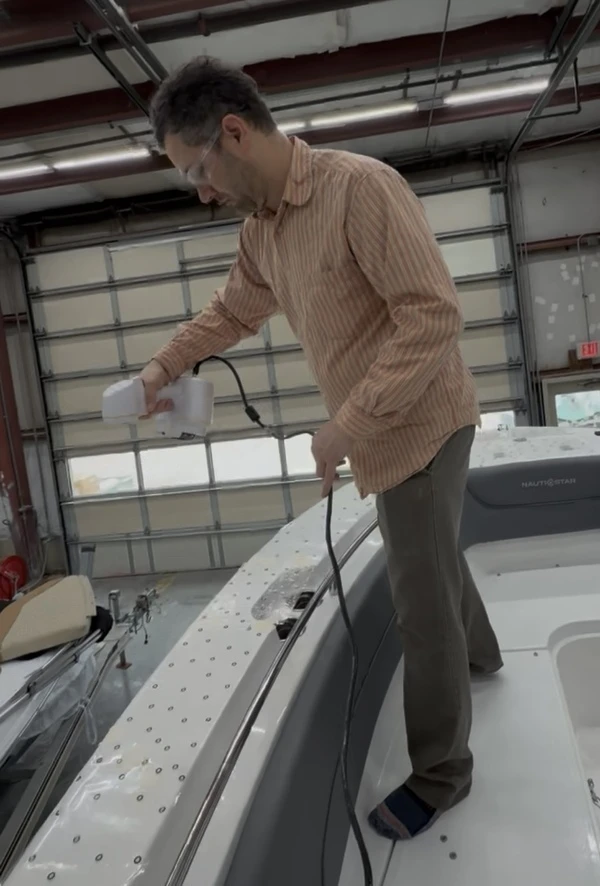
Q: How does the Peel 3 3D scanner improve outcomes for refits, retrofits, and accessory design?
A: Eliminating the guesswork! This enables faster design cycles, better first-pass success, and cleaner installations with tighter tolerances and higher perceived quality.
Q: What advantages does 3D scanning deliver over traditional measurement methods?
A: Speed! Minimizes human error. You have a digital copy (mesh) you can always refer to, especially when this physical part is no longer available. Development moves fast in this industry, you must capture the data when it is available, or you might miss that opportunity indefinitely.
Q: Where does 3D scanning fit into naval architecture and hydrodynamics work?
A: Marine vessels are very large in scale. The cost is very high to run physical real-world testing. Scanning allows the naval architect/engineer to take that data directly into CAD/CFD workflows to evaluate numerus factors.
Q: Can you talk about reverse engineering and scan‑to‑CAD services for shipyards?
A: The marine industry is notorious when comes to hand build, legacy parts, undocumented builds, changes that were not captured and updated during development. It is especially bad for aftermarket efforts. Original data often does not exist and will need to be recreated from scratch. Scanning speeds the workflow, minimizing risk and guesswork.
Q: What’s the ROI for marine teams—where do the savings and gains show up?
A: Savings shows up in reduced hour demand for skilled/professional personal, reduced waste of expensive material, and overall product value gains show up with the improvements in the fit and finish quality.
Boat builders typically operate with very small teams of engineers and designers, all possessing a variety of skills and responsibilities, each overlapping each other and integrating on the same project. Scanning eliminates guesswork, reduces costly trial and error during development and fabrication. It improves first-pass success rate, which can be critical for this type of industry.
Curious to learn more about how 3D scanning is transforming the marine industry?
Read this application study case to learn more about the implementation of 3D scanning in the marine industry Modus Boat blog article.
Wonder how Peel 3D can transform your work, solve problems, and save you time?
Contact our Peel 3D experts